
In Bugonia, Teddy doesn’t lack intelligence. Quite the opposite. He sees patterns, connects dots, and builds a coherent story of the world. The problem is that he never doubts the story he tells himself. Once he convinced himself he was right, everything that followed became justified. Most of us like to believe we’d notice if we crossed that line. Bugonia suggests otherwise.
On the surface, the plot is all about conspiracy and madness. At the same time, it asks what happens when thinking outpaces cooperation, and when intelligence is crowned as wisdom. Teddy believes he’s acting in service of something larger than himself. The film leaves us with a harder question: how often do we do the same — individually, socially, and at scale?
Possible spoilers ahead.
The stories we feed each other
The internet is a consumption-driven environment, narrated by algorithms that learn what we want to hear and make sure we keep hearing it. Combine this with the modern worship of individualism, and you get people who experience the world mainly as a reflection of themselves.
What happens to a highly intelligent person inside a perfectly curated information cage? At the extremes, the story tends to unfold in one of two directions:
- They achieve “brilliance”. They are confident, articulate, and convincing. They are never wrong, until they become dangerously so. They make excellent politicians, financiers, or cult leaders — roles where being sure matters more than being right.
- They turn into a conspiracy engine. They see patterns no one else sees and mistrust any “mainstream” reasoning. They sink so deep into their rabbit hole that they construct a world model of their own.
An example of the second is Bugonia’s main character, Teddy. He sees himself as a savior, but, much like a self-deluded superhero, we are left to question if the damage he causes can ever be justified.
On the other end of the spectrum are people like Don, who listen to and abide by the rules of their respective authorities. They may lack answers, but they understand something Teddy doesn’t: survival is collective.
There will always be power in the stories we feed each other.
But if we tell each other the wrong stories, we can just as easily skip straight to the ending.
The poor stay poor, the rich get rich
We talk about intelligence as if it floats above circumstances, but reality looks different. As class inequality widens, people become increasingly trapped in their own worlds, leaving little room for global problems.
For the poorest, no amount of intelligence compensates for life in constant uncertainty. Survival requires full attention. So much so that other issues remain a faraway background that comes into view only once in a while.
The middle class is aware of global problems but has limited power to change them. Actions like recycling and public transport provide moral relief, but barely register inside systems designed to exploit everything for profit. These people are also under constant pressure: mortgages, childcare, debt, and the quiet threat of downward mobility. And even if they keep up with all that, automation and economic volatility turn long-term planning into risk management.
The wealthy occupy a different reality altogether. They hold the most power, shape major decisions and suffer few of the consequences. It’s hard to feel urgency when nothing is at stake for you. As a result, we tend to solve global problems only once they start threatening existing power structures.
Class division keeps us intelligent in isolation. It makes us stay in our lanes. People optimize locally and hope someone else handles the rest.
Everyone wants to save the world, they just disagree on how.
Attempts to ‘save the world’ tend to clash long before they coordinate. Bugonia follows an individual certain of his plan. Fallout shows what happens when that same certainty is distributed across groups. Neither approach actually works.
The system tolerates many competing plans. It resists a shared one.
When intelligence remains uncoordinated, failure is the default outcome. Unless we find a unified way forward, exterminating ourselves might be the most intelligent solution.
The suicidal gene of humanity
If humanity has a self-destructive trait, it isn’t stupidity. It’s how effectively we justify our own actions.
Violence is a recurring pattern in human history. We haven’t had a single year without bloodshed. Even after World War II, humanity found much to disagree on. War is a tool that still works at the top.
If anything, intelligence refines the process. It helps to justify, optimize, and defend violence as necessary. The same logic applies at the individual level as well.
War is such an integral part of our species that we’ve mastered the art of marketing it. We wrap it in flags, values, and symbolism until it feels inevitable. Our intelligence is better at rationalizing violence than at dismantling the conditions that produce it.
What persists across generations starts to look less like choice and more like inheritance.
When will they ever learn?
Large-scale cooperation has never been our strong suit. Historically, we only agree to it if institutions or technology force us. But that introduces another layer of instability.
If humanity is trapped in an endless cycle of violence, long-term survival is questionable.
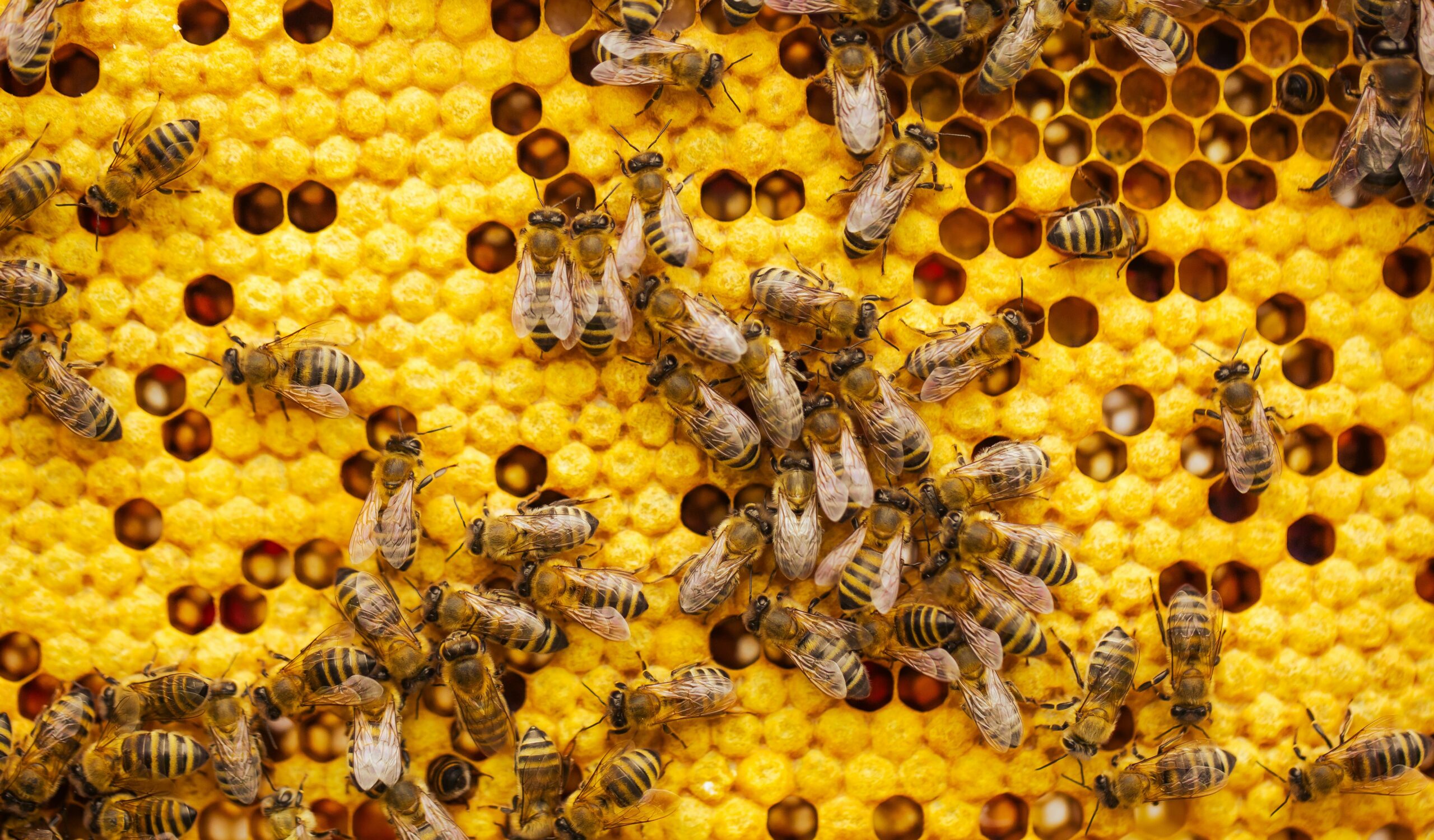
“Bugonia” is a symbol of life arising from death. It is an ancient belief that bees rise from the corpses of sacrificed cattle. Using this belief, the film uncovers an unsettling idea — the planet may recover only once we’re no longer the dominant species shaping it.
Until we stop focusing our intelligence on individual gain, we’re unlikely to change our ways. We keep leading ourselves to a violent end. But not every system behaves this way.
The resolve of bees in the face of peril
Bees don’t solve problems by debating values or assigning blame. They respond to signals, feedback, and constraints. When conditions change, behavior changes with them.
A hive doesn’t depend on a single decision-maker or a shared story about purpose. It functions through distributed effort, constant adjustment, and a clear priority: survival over status. There’s no room for individual gain at the expense of the colony. Immediate feedback ensures that such actions fail quickly.
Humans understand this in theory. In practice, we keep rewarding the opposite. We prioritize growth over stability, dominance over coordination, and narratives over feedback. Our intelligence is spent explaining why this is acceptable, or unavoidable, or someone else’s responsibility.
Bees don’t need to imagine themselves as saviors. Their success comes from aligning behavior with constraints rather than trying to outthink them.
Our intelligence won’t save us if it keeps reinforcing the same incentives. Bugonia shows what happens when certainty replaces coordination. There isn’t a single solution waiting to be found. What’s left is slower, less dramatic, and harder to reward: countless local changes built around feedback, efficiency, and collective stability.
If an “alien” ever decides to press the button, we won’t be able to stop it. But we can still decide whether intelligence continues to serve dominance or finally learns to work within limits.